Monday, March 7, 2016

Teen Sugar Highs + Hydrogen Breaths

Sitting in the waiting room of pediatric gastroenterology, the double stroller next to me contains two young children, both with hacking, productive coughs. My son has just ingested 44 grams fructose and we’ll be here for the next three hours or until he “breathes a 20” on the handheld hydrogen breath test, whichever comes first.

Our pediatric GI relationships began shortly after his birth when he was diagnosed with gastroesophageal reflux disease, or GERD, and began losing weight at the wee age of four months. Major surgery was recommended and we deferred hoping to find a less invasive solution. Oddly enough, we found chiropractic care. Physical adjustment, combined with Prevacid, kept his ruminations below 30x day and took him off the short list for a fundoplication. He began to thrive.

Reflux has never vanished from our lives but everything has been manageable, until recently. At 13, my son is 5’6”. He stands a full 2 ½ inches over me, yet cannot seem to break the plane on 100 pounds. And a couple of months ago, he started losing weight.

As a mother, I have extensive on the job training and a high comfort level with acute illness, first aid, sugar-induced hyperactivity, night terrors, friend problems and homework frustration. Another “failure to thrive” diagnosis, however, prompts only dread.

At the most basic level, I just want to fix things. I have gut issues, food allergies and intolerances and I know just how frustrating it can be to have persistent tummy troubles. The teenage years are fraught with so many other speed bumps, concern about what you can and cannot digest effectively enough to maintain your body weight shouldn’t have to be part of the process.

So, after a two-week elimination diet, a course of probiotics and a trial of high fiber supplementation, Dr. A has suggested we run a hydrogen breath test. We are testing for a fructose malabsorption problem. So after swallowing the equivalent of a bag of Skittles dissolved in water, we’ll hang out in the waiting room for a couple of hours. Every thirty minutes, the medical assistant will bring the breath test to us and Ri will blow into it. His baseline parts per million of fructose was zero so a positive test is a reading of 20ppm at any time.


Unfortunately this test only measures hydrogen production and approximately 35% of the population actually produces methane rather than hydrogen with a malabsorption issue. In other words, we could leave here with no answers.

And then there is the perspective of the past few weeks and past few years: things could always be worse. This particular issue is disconcerting, frustrating and a definite annoyance but Ri is bright, happy and generally healthy. 

So, after a 12 hour fast, and a couple of hours hanging out with sick, and vocally unhappy children, at least our next steps are clear - he has already chosen his post-sugar high lunch spot.  


NOTE: This post approved for public consumption by the 13-year old. 

Thursday, February 18, 2016

Sitting with my Emotional Salad Bowl


Exactly two hours before my six-month oncology checkup and I find myself in that odd space between emotion and logic. I am ridiculously nervous and yet cognizant of the fact there really isn’t anything to be nervous about.

But my anxiety is real and I’ll own it. If I’ve learned anything over the past few years, I have learned that leveraging logic to ward off fear and anxiety takes more far energy that simply leaning in and embracing the emotion. All things flow more smoothly when I sit with my emotions and allow my emotions to sit with me.

While I’m sitting and ‘owning’ my feelings, I’m acutely fascinated with the dichotomy between my “rational brain” and my “less rational, more emotional” side. So I’ll give them both a voice. (Some people prepare for appointments using mindful meditation or distraction techniques. Evidently I just type.)


Logic says: There is no magic test for breast cancer recurrence. Today is a checkup. Nothing will happen. I will meet my oncologist, she will ask how I’m feeling, she will examine my reconstructed chest and check for lumps, bumps, soreness, etc. She will ask how Tamoxifen is going and I will give her all of the gory details. I’ll ask her to refill my prescription and I’ll ask for assistance in finding a new primary care provider since mine has left the practice.

Emotion says: There is no magic test for breast cancer recurrence. Today is supposed to be uneventful. But. Your baseline mammogram was supposed to be uneventful and the @#%! hit the fan in a big way at and after that appointment. The real albeit less-rational side of me is also assessing all of the other ‘health issues’ going on right now and wondering, quite frankly, “Is this cancer?!”

The logical response is, “No, your GI issues probably have nothing to do with cancer” but logic doesn’t always reign supreme in my noggin. The logical response is, “No, your newly wonky menstrual issues probably have nothing to do with cancer” but saying those words aloud don’t really allay my fears. The logical response is, “No, the slightly enlarged lymph nodes in your left armpit probably have nothing to do with cancer.” 

The little-bit-less-rational-and-slightly-alarmist side says,  “But. Just but.”

As this emotional/logical ping pong goes on in my head and the clock moves ever closer to appointment time, I’ve just realized another emotion is peeking out from behind the anxiety: eagerness.

Truthfully, I’m actually a little excited. On the heels of attending January’s Survivorship Symposium and a couple of weeks prior to this appointment, I emailed my oncologist to ask her for a survivorship care plan. She said she’d, “pull a packet” for me and I’m eager to see what makes up my plan. My expectations are low but I’ll consider whatever documentation I am provided a starting place to build something that truly meets my needs. From there I’m excited about helping others access and develop care plans that will meet their needs.

Anxious, afraid, excited, eager. (Sounds like I’m preparing for a skydiving adventure rather than an oncology appointment.) Looks like I’ve got a veritable emotional salad bowl.


I’m not entirely sure how these feelings will play out, amp up and/or dissipate over the next 90 minutes but I do know that my appointment will likely end the way it always ends, with a hug and overwhelmed with gratitude for another six months of no cancer and an incredible circle of support.

Friday, January 22, 2016

Survivorship Innovation with a Dose of Reality


As I sit here reviewing tweets and abstracts from last week’s Survivorship Symposium in preparation for the upcoming #BCSM tweetchat, I feel compelled to share a personal moment in time from last week and a moment that defines much of what it means to be an educator and advocate for those affected by cancer.

The inaugural Suviviorship Symposium was held in San Francisco, CA January 15th - 16th and was cosponsored by ASCO, AAFP and ACP. If the diversity in conference sponsorship were somehow insufficient, the diversity of specialties in the room confirmed that the needs of patients before, during and post active treatment were of primary concern. Onocologists, radiologists, primary care physicians, nurse navigators, cardiologists, epidemiologists, internal medicine docs, patients and patient advocates were all well represented.  As a patient and an advocate, I felt only acknowledgment and validation from the healthcare community that survivorship comes laden with its own burdens that for most people, involve physical, social, financial and emotional impacts. 

Innovative and integrative methods of whole person care were highlighted as ways to address these unique needs.*

High on the innovation and progress in the #SURVONC16 conference, I received an email. The first line tried to prepare me for the content:

“It is with a heavy heart…”

Those are the worst kinds of emails. To write and to receive.

I sat through a few more minutes of the presentation but suddenly the technical was uninteresting and I was unfocused. I left with my coffee mug in hand to wander, leaving a post for those who were closely following the conference via my tweets:


Like a fist in the chest.

I wandered upstairs to the poster session where coffee and tea are always readily available. I tried to take solace in the fact that this woman was an 18 year survivor before cancer killed her but, as I did the math, I realized if I were to ‘achieve’ living 18 years beyond my diagnosis, I would die at 58. I would leave my husband spouseless at 62. My youngest child would only be 28 years old and I may or may not have gotten to hold a grandchild in my arms. The tears brewed but didn’t spill over.
A young woman was creating a coffee masterpiece with cream and cinnamon and hazelnut syrup. The concoction was a sight to behold for a caffeine junkie like myself and I commented favorably on the dessert coffee. She mentioned she was unable to focus so thought coffee would be a good solution.

I mentioned I was also unable to focus so I was switching to tea.

I introduced myself and discovered she was local to SF and actually an infusion nurse. I thanked her for doing what she does on a daily basis and we began talking about survivorship programs. The distraction was nice but when I became excited about what her institution was rolling out, tears began rolling down my cheeks.

I explained that I wasn’t crying because of what she was saying but that I was struggling with the dichotomy between the innovation and energy downstairs and the reality that a woman just died.
If you want to understand the source of proverbial fire in an advocate’s belly, you likely have to look no further than their connections to others. Others who are suffering, others who have died and others who hold significant risk for being tracked into the health care system as a critically and/or chronically ill patient.

In a period of minutes I felt the emotional dichotomy between hope and despair. The future is bright and yet, for some, the future is not an option. As I stood there, trying to get it together, this amazing coffee concoction creator and compassionate infusion nurse reached out and gave me a hug. We chatted for a bit longer as I tried to reorient my focus on the present and the promise for the future even though I know many of the amazing people I learn with and from won't necessarily be here for that ever elusive 'future'.

So, when people ask why I remain steeped in the cancer space and why I spend my time working to change the slow moving goliath of a complicated health care system I give them a variety of authentic answers about making a difference, changing the system and working with amazing people trying to solve really complicated problems.

And, while all of the above are authentic reasons, ultimately my answer is: 

Someone has to because the status quo just isn’t working. 


*A more complete blog regarding themes and content of the Survivorship Symposium will be created and posted at #BCSM.


Tuesday, December 8, 2015

My Neuroses are Showing


I cancelled my brain MRI.

For months I have been putting off the six month ‘check-in’prescribed by my neurologist. My aversion to the test is complicated. This would be the third brain MRI I’ve had in 18 months and the fourth MRI with contrast I’ve had in two years. Occasionally my scanxiety is related to what we might find but, more often than not, my larger concern is the safety of the contrast. Then there is the obvious question around what happens if we actually find something. Yes, I realize that my neuroses are showing.

Ultimately I keep coming back to a statement I’ve heard repeatedly by physicians and patients alike, “Skip the scans and get busy living.”

I have been busy living. But sometimes I feel like the ‘busy’ is more of a frenetic “HOW MUCH LIFE CAN I CRAM IN?” kind of a busy as opposed to a more patient “I’m savoring every possible moment on the planet” kind of busy. I want to achieve the latter but I sense I am kind of stuck in the former.

After the $hitty Summer of Cancer, I left the high tech industry and focused my skills in the world of community and patient engagement. I love connecting people to people, people to organizations, information to patients and most of all, I love helping patients find their “outside voice” while navigating the healthcare system. But there is a flip side to the warm fuzziness of what I do. I continually work with people who are dying faster than the general population. For as ecstatic as I am every time a friend receives a status of NED (no evidence of disease), I am emotionally pummeled when their cancer advances and I am thoroughly devastated with news of their deaths.

If I were good at compartmentalizing, my personal disease roller coaster might not be so rollerly. But, I’m not good at compartmentalizing. I absorb the energy of those around me. I connect with these people, their stories, their fears and hopes and dreams. And I can see myself in every one of these stories.

And, when I look at how quickly the health and wellness tides can turn, I feel like my focus should always be to participate physically and emotionally to the utmost in life. Anna Craig has called this “living condensed.” I love that term but am finding the realities of living a full life challenged by the realities of living a life within the realities of my life challenging. How’s THAT for meta?

There are so many things I want to write about but they all feel stuck somewhere between my brain and my fingers. I want to write about gratitude. I want to write about despair. I want to write about fear. I want to write about hope. I want to write about anger, hate, love and what comes next. I want to write just to get the emotional baggage out of my head and off my proverbial back. I want to write to help others in the same boat realize they are not alone.

So rather than sit around cursing my current inabilities, I’m breaking things down remedial writing style. Apologies in advance.

Gratitude: Gratitude is a fat, self-nurturing emotion. Filled with the heaviness of being thankful, I feel happily bloated physically and emotionally. Perhaps ‘bloated’ isn’t exactly the right terminology. Sated? On Thanksgiving Day, my family and I were wandering around Florence, Italy with dear friends (our Framily) stuffing ourselves with gelato and high on espresso and life. On November 30th I quietly celebrated the two year anniversary of my very first gratitude party. Just six months from diagnosis and thrilled to be cancer-free I had hoped the party would put the period on the $hitty Summer of Cancer. While it did not, the party was a huge milestone and I’m happily, bloated-ly, sated-ly grateful to be cancer-free another two years later.

Despair: Just days before returning home from our whirlwind Italian tour, I read the news that Maria Fowler had died. Maria was a member of the #bcsm community and metastasized earlier this year. Her death, like so many others, brings home the reality of a disease that kills over 110 people per day.
 
Fear: I am afraid. Not every day but sometimes. I am afraid of cancer returning. I am afraid of not living every day to the fullest. I am afraid of treatment. I am afraid of screening (most notably the brian MRI I have put off yet again). I am afraid of being too afraid to enjoy the gifts that surround me every damn day.

Hope: When people question how I can surround and immerse myself in the cancer space on a daily basis, I remind them (and incidentally myself) that this community is full of hope. And, as with any community, when one member loses hope, we hold hope for her until her hope energy returns. Every time I connect individuals I do so with the hope that we become closer to moving mountains. Because we are all stronger together.

Anger: I am angry at the bureaucracy of a healthcare system that often marginalizes patients to a member number and a set of ICD codes. I am angry that with all of the advances in research, we still have people dying because they are unable to access a particular treatment. I am angry that, in a country as resource wealthy as ours, people’s life spans and quality of said span are often determined by their zip codes. I am angry at diseases and at individuals who take others’ lives with blatant disregard. I am angry that I waste my precious time being angry.

Hate: Why? Why? Why? Is it really so difficult for humans to realize that we are all more similar than different? Global events that boil down to a hatred between ideals taken out on individuals stupefies me. And, as I mentioned before, angers me. It also saddens me. Beyond words.

Love: More love please. I love working with brilliant, compassionate people that can and will change the world. I love that I wake up every morning and have another day with which I can experience, share, learn and do.

Tossing out sincere apologies for the structure of this post and gratitude for the ability to finally get a few of these things off of my proverbial and literally reconstructed chest.

What comes next? I’m not sure. Tomorrow comes next for many of us. I still vow to treasure each day but I also commit to not putting such an undue amount of pressure on the treasuring part that I forget to actually enjoy tomorrow. And that MRI? Eh, we shall see.


Wednesday, October 28, 2015

Paradigm Shift Please: Reactive to Proactive; Illness-Based to Wellness-Based


Yesterday evening I had the good fortune to participate in the first half of the weekly Healthcare Leadership chat (#hcldr). As always the audience was filled with a combination of clinicians, patients, advocates, techies, community builders and those of us who don many hats. As always the conversation was rich and thoughtful. And, as sometimes happens, there was a tweet that stuck with me for hours and my 140-character response feels insufficient to address the concerns I have.

The conversation and the chat questions revolved around the similarities, differences and potential applicability of humanitarian efforts, like those of #hcldr guests Doctors Without Borders, to population health. Again, relaying the richness of the conversation is not my intent and will not be relayed in this post. Instead a single tweet seems to enunciate for me one of the challenges we have in healthcare today. And, as the oft-quoted G.I. Joe reminded me and countless others in the mid-80s, “Knowing is half the battle.”

The second chat question was “What should be the standard of care in low resource settings?”

My initial response was:


As I typed, I realized how ethnocentric my response was. Zip Codes is US terminology. Fail. My intent was to convey that regardless of where a person lives, or their forced standard of living, their personal choices should absolutely be respected.

The T2 response that raised the hairs on the back of my neck was the following:


Depending on how I read this statement I either agree or vehemently disagree:

  • In a resource limited environment, prevention or risk reduction should be fundamental. AGREE.
  • In a resource rich environment, prevention/risk reduction is less important and treatment after the fact is okay because it’s available. Vehemently DISAGREE.


After a bit of a back and forth online, I am 100% convinced Brian intended his statement in the manner with which I agree. However, the statement and the conversation bring up a much bigger issue and a much bigger reality.

Our US healthcare system, in a resource rich area rife with pockets of inequality, is an illness based system. By and large we wait for people to get ill, treat them, treat the side effects of treating them and then treat them when the original medicines/treatment produces unintended negative consequences.

Focusing on risk reduction and prevention where prevention is possible is THE absolute way to go, regardless of zip code, latitude, longitude, ethnicity, socio-economic status or any other defining characteristic demographic. There is absolutely no such situation where improving heath literacy, personal accountability for health and striving to reduce the incidence of disease doesn’t make sense.

Resource limitations are relative. In instances where clean water, shelter and food are scarce, resource limitations are obvious. However, when we look at elements like clinician burnout, appointment backlogs, insurance reimbursement backlogs, caregiver energy, patient emotional well-being, caseload overload, etc. we can and should consider such resources as limited. The mindset that, in ‘resource rich’ areas we have the luxury of focusing on illness treatments rather than reducing incidence and prevalence of illness is, to be blunt, bass-ackwards.

Nearly a year ago, I created a flip idea based on generating incentives to shift from an illness based into a wellness based system. Flip 28: Create Preventive Care Incentives: Incentivize patients for on-time wellness and preventative care. 

Admittedly, this was my first flip and the content was lacking some of the specifics that would have made it easily actionable. But it is still a damn good idea. I’d like to resurrect the idea and join forces with those who already see the incredible need and benefits from shifting from reactive to proactive mode in healthcare. I’d also like to help highlight people and organizations that have achieved success with a preventative care model because, for some, the catalyst for change is the ability to visualize prior successes.

Just because people can afford treatment doesn’t mean that treatment is the ideal course of action. Imagine the emotional and financial benefits to reducing illness risk in individuals and preventing illness in the population. Imagine the luxury of a system not overtaxed with sick that has the ability to spread valuable resources to areas that require treatment. Imagine a healthcare system that focuses on protecting health rather than trying to re-establish a quality of life after the devastating impacts of chronic disease.

In partnership with others, I’d like to shift the paradigm from: “In a resource limited environment, prevention or risk reduction should be fundamental” to “In every environment, health education and support to drive personal risk reduction and population disease prevention is fundamental.”

Please let me know if you’d like to help.


Friday, October 2, 2015

Five days, three cities, two conferences and one triathlon


Five days, three cities, two conferences and one triathlon.

It was a busy week.

Last year I crashed the Stanford Medicine X party for an evening social. This year I was the fortunate and very grateful recipient of golden tickets from two well-respected innovators in the healthcare space. Anne-Marie Cunningham got me in the door at MedX Ed, a two-day medical education conference focused on the question “What if we…?”
And GillesFrydman, founder of ACOR and co-founder of SmartPatients, expanded my pass, and my mind, by welcoming me in to the official 3-day Medicine X escapade.

In between the two, I was fortunate enough to attend the first day of morning sessions of ASCO’s Breast Cancer Symposium to not only learn about the latest and greatest in breast cancer research and treatment but to meet a handful of luminaries in the field and especially in the world of #BCSM.

My conference goals were simple:
  • Learn as much as possible across both conferences
  • Meet the multitudes of people who have been so instrumental in my healing as a breast cancer patient and my evolution as an advocate
  • Live tweet as much knowledge to the masses who are unable to attend in person

Before the learning could commence, the gratitude had to be expressed.

The magnitude of positive impact on the following individuals is difficult to articulate. Whether they provided emotional or educational support or whether they simply are leaders in the space of patient activism, each one of the following people has been fundamental to my growth as a patient, as a person, as an educator and as an advocate.  

Each long-awaited face-to-face encounter was like unwrapping a present that you've anticipated for years. Words were pretty inadequate for some of these in-person 'reunions' so hugs were a defacto replacement. 


Hanging out on the West Coast with Alicia (@stales)
Becky (@rjhogue), me & Marie (@JBBC)

The highlight of MedX Ed Day 1 happened moments after I entered the main stage area. Attending with a friend who also planned to live tweet the event, we chose a high table in the back for its access to power and laptop space. Within minutes of setting up shop, Dave deBronkart walked in. Dave is a founding father of the ePatient movement, fondly referred to as @ePatientDave and a man I’ve wanted to meet for some time. He has his own cancer story but, in my mind, the most powerful part of his story is not thriving eight years after a Stage IV cancer diagnosis, it is the empowerment he has modeled for all patients that received a diagnosis since declaring himself an e-patient in 2008.


MedX Ed vacillated between a sage on the stage model and an intimate series of breakout groups focused on transforming the educational experience for the medical community. We shared our personal experiences with social media as a tool for education as well as the power of stories and experience to help generate understanding of the patient as a whole person beyond their disease. There were several occasions where the #IWishMyDoc / #IWishMyPatient theme surfaced and each occasion was met with spirited and respectful conversation about the need to create an environment of trust, respect and empathy that focuses on patients as more than the sum of their diseases. 

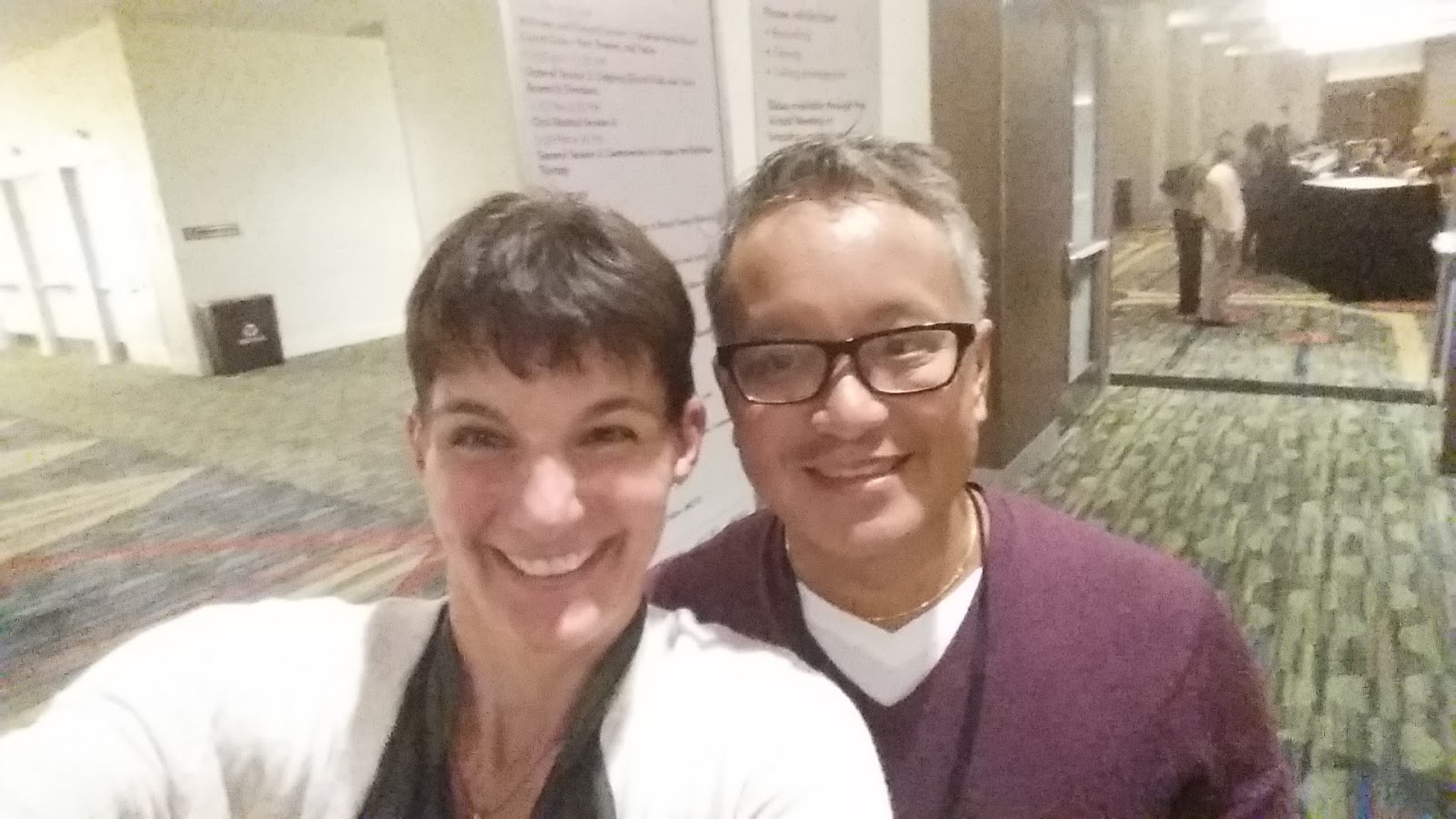
On Friday, I trudged through morning traffic to San Francisco for #BCS15. My first priority was to meet Dr. Deanna Attai and give her my very personal thanks for all of her contributions to the #BCSM community and the breast cancer community as a whole. We found each other just prior to the opening session and, without hesitation, she said, "We must take a picture!" In the #BCSM community, it is widely understood that, if there is no photographic proof, it simply could not have happened.


As we listened to the "State of the Art Breast Cancer Care: Past, Present and Future" I tried to live tweet as much as possible but found myself needing to focus on the rich content in order to understand it. I saw my disease pathology discussed and took away a few key nuggets:

"Chemotherapy only effective in preventing early (first 5 years) recurrences" 
Personally this statement makes me even more comfortable with my decision to have the OncotypeDX test and avoid chemotherapy.

"Late recurrences remain a major problem" 
Personally, this statement scares the $hit out of me which I why I continue to educate others on the needs and benefits of focused research.


In between presentations, I was also fortunate enough to meet Dr. Don Dizon, a physician well-versed in bringing up topics otherwise swept under the rug, namely the sexual side-effects of disease and treatment. 


On Friday afternoon, I traveled 20 miles south back to Palo Alto where it was 20 degrees warmer and might as well been a difference conference planet. The Breast Cancer Symposium followed the classic, if antiquated model of presenter after presenter in a large ballroom. MedX followed a similar large main stage concept but augmented the stage with club lighting, club music, a plethora of balloons and various statues of Zoe Chu, the MedX mascot.

The REAL Zoe Chu & Alicia


The environment was fun and energetic but the advocate in me kept considering how many additional patient and/or med student scholarships could they have extended if some of those dollars were spent differently.


 Left: A little lunch break with the inspirational Liza Berstein (@itsthebunk) & #HCLDR co-founder Colin Hung (@Colin_Hung)

Below: Finally meeting Natrice! (@Natrice)

Saturday morning, rested and rejuvenated I chose to zero in on a single conference rather than split my time again. I chose MedX for the workshops and small breakouts as well as the mainstage lineup. More heartfelt meet-ups turned tweet-ups but none more exciting than being gifted my pink socks by Bill Kelly. The #pinksocks began at HIMSS when ReelDx COO Nick Adkins donned them reminding us all that we are driving a healthcare revolution, starting from the ground up. I have coveted the pink socks for many months and so I promptly donned them, to the excitement of many and the consternation of anyone with any fashion sense.   


Although both conferences were to continue on Sunday, I knew Saturday was my final conference day. Sunday had been spoken for months before by a friend who wanted to complete her first triathlon. We had matching tri suits and it was a high priority for me (despite the fact I had not been swimming since my mastectomies!).

So Saturday evening turned into a bit of a dance party as ePatientDave passed around vintage ePatient t-shirts and we grooved in our matching pink socks to Bruno Mars “Uptown Funk.” 

As we were getting silly, DarlaBrown and Molly Lindquist approached me, “We are SO excited to meet Coffeemommy.” I was taken aback. The tone of their voices, their eye contact and their smiles convinced me they were authentic in their eagerness and excitement and I was honored but also a little amazed. 

Feeling that I had made an impact on the very people I felt made a considerable positive impact on me was a fantastic way to close the evening. It really is all about connection. In healthcare and beyond.


As a side note, Darla captured the mini dance party via periscope but, when you’re singing and dancing with Dave video is the least of your worries, keeping up is the only thing that matters!

MedX was amazing yet I left with a sense of urgency beneath my connected contentment. In the confines of MedX, we were all preaching to the choir. Everyone who attends already 'gets it' and now the biggest challenge lies ahead - how do we take our collective knowledge, insight, passion and energies and catalyze change.

Sunday dawn broke as my friend Nichole and I drove over to the East Bay for her first ever sprint triathlon – SeeJaneTri. Nichole and I walk every week – Half Marathon Mondays – but neither of us had swum, biked or run in quite some time. To be fair, I’ve spent a lot of time pedaling but my concerns for the bike were centered around remembering how to shift, steer and brake.

Our triathlon goals were also simple:
  • Don't drown
  • Finish with a smile

We arrived, two nervous women in a sea of nervous women. 

On the heels of hanging with my Transformational Healthcare Twitteratti, I was well aware at the most visceral levels that we are all more similar than different so, I did what I ALWAYS do in times of stress and uncertainty. 

I talk to people. To hear their thoughts, consider their advice, share their energy. 

We met a handful of women also nervous about the swim. Just knowing that you are not alone in your fears is healing – in the cancer space, in the chronic disease space, in the triathlon space – in EVERY space. Community is inspiring, healing, motivating and comforting. 

Working off some pre-event jitters with some stink-eye.

Sunday felt like a different planet from the connected health education experience of days prior but, at the very core, it was exactly the same: we are  absolutely stronger together.


Thursday, September 17, 2015

There is No “Good Cancer”


A friend recently tumbled out the words that I remember being stuck in my own throat two plus years ago, “I have cancer.” We traded some swear words about the whole affair and then I did what I’ve done consistently for the last couple of years, I set about researching her disease and her treatment options. Imagine my surprise when I discovered her cancer being described as “the GOOD cancer.”

Full stop. A good cancer?

That would be an oxymoronic (emphasis on the moronic) statement if I ever heard one.

Cancer sucks. Regardless of the type of cells choosing to go rogue.

Cancer is the antithesis of ‘good.’ Beyond the immediate surgical, chemical or radiological treatments, cancer means always looking over your shoulder. Cancer means overthinking every ache, pain and bruise. Cancer means adding the “mean survival rate” years to your current age and subtracting the years you’ve been cancer free. Just to check again whether or not the probability exists that you will see your children graduate from high school, choose a life partner, have children, grow old with your spouse.

Cancer is a thief. It takes pieces of your body and it takes your peace of mind.

Mere weeks before my friend was diagnosed with thyroid cancer, another friend was diagnosed with ovarian cancer. Opposite ends of the body yet very common in the shock, frustration, anger and periods of soul-crushing fear.

In the cancer community, we are all more similar than different.

September is National Ovarian Cancer Month. Ironically September is also Thyroid Cancer Awareness month – I Googled it. And, for as steeped in the world of oncology as I am, when my daughter asked me what color the solidarity ribbon was, I had to Google that too. In other words, for as in touch as I am in the cancer community, I am ignorant regarding the ins and outs of thyroid cancer awareness.

But I am absolutely aware that there is no such thing as a “GOOD cancer.”

There is, however, good research. And we need more of it.
Please take six minutes to watch the American Academy of Cancer Research 2015 report video showing what good research can mean to individuals and their families:


Cancer treatments can only be improved with adequate funding of research. We need to move well beyond the ‘awareness only’ phase and onto the ‘focused action’ phase.

All cancers suck. But focused research that extends treatment options and quality of life is GOOD.